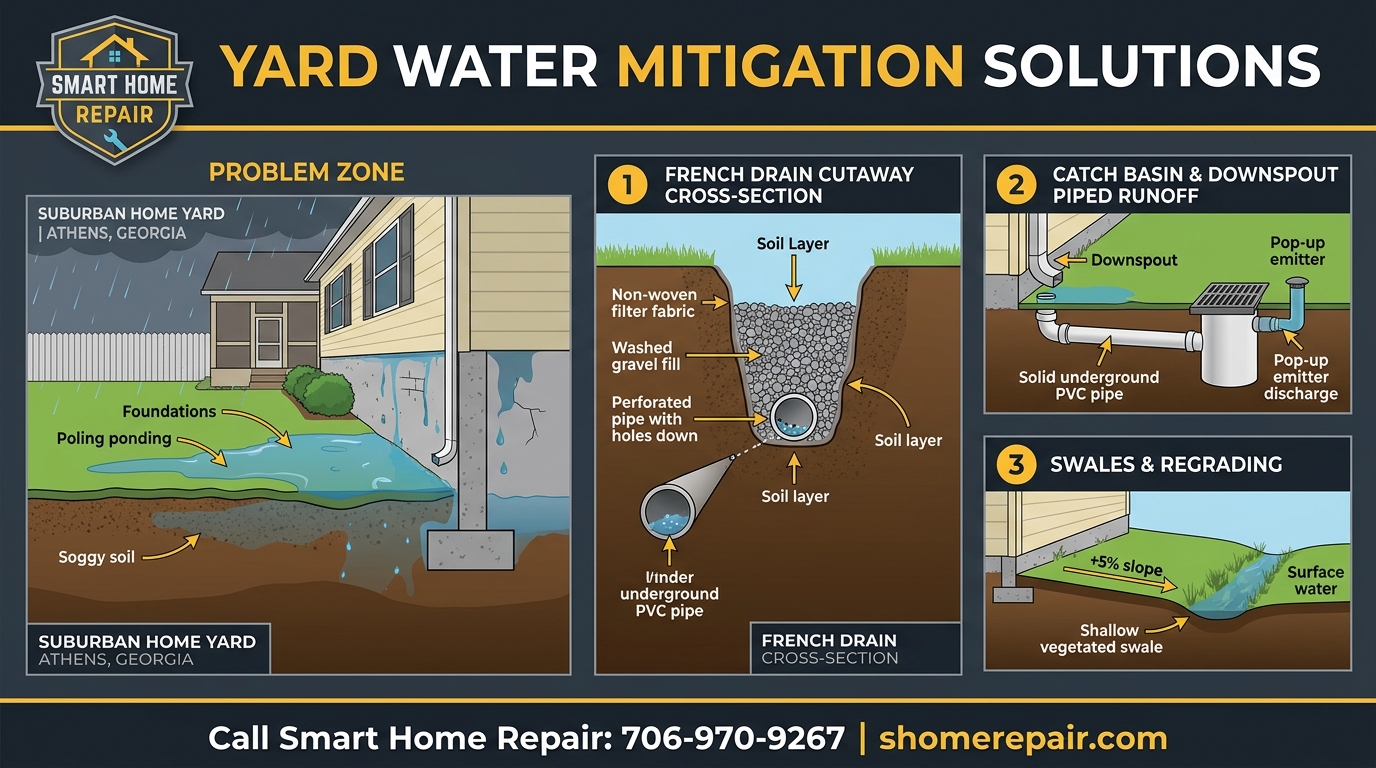
Site Assessment & Soil Hydrology
Water Pooling & Foundation Moisture Risks
Unmitigated rainwater accumulation near residential foundations causes structural, health, and cosmetic damage over time.
- Foundation Seepage: Standing water against concrete footings leads to hydrostatic pressure, wall cracks, and basement/crawlspace dampness.
- Georgia Red Clay Saturation: Clay soils in Athens have poor percolation rates, retaining surface water long after storms pass.
- Soil Erosion & Low Spots: Unregulated runoff washes away topsoil and creates stagnant puddle zones in lawns.
- Crawlspace Mold & Rot: Excess exterior moisture migrates under floor joists, encouraging wood decay and high indoor humidity.
Athens, GA Hydrological Profile
Athens averages 48+ inches of annual rainfall. Combined with heavy Georgia clay (Piedmont Ultisols), surface runoff cannot soak down naturally fast enough.
Key Technical Rule of Thumb:
For every 1,000 sq ft of roof area, a 1-inch rainstorm generates approximately 623 gallons of runoff. Without proper piped discharge or swales, this massive water volume dumps directly against the foundation walls.
Engineered Drainage Solutions
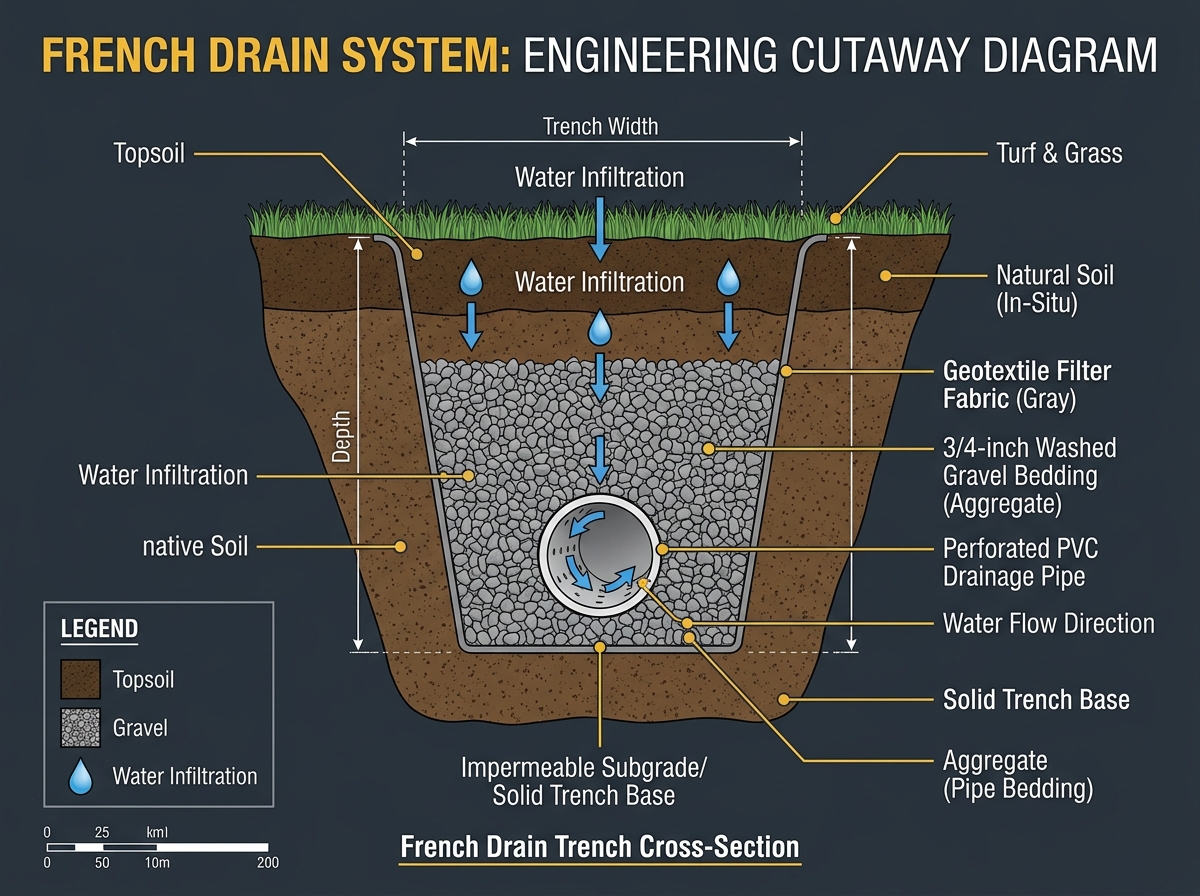
French Drain System
Subsurface groundwater management featuring a sloped gravel trench with non-woven filter fabric and perforated pipe to intercept groundwater before it reaches the foundation.
- Trench Depth: 18" - 24" Deep
- Pipe Specification: 4" Perforated PVC / Slotted
- Filter Fabric: Non-Woven Geotextile
- Aggregate Fill: 3/4" Washed River Stone
- Best For: High Water Table & Soggy Lawns
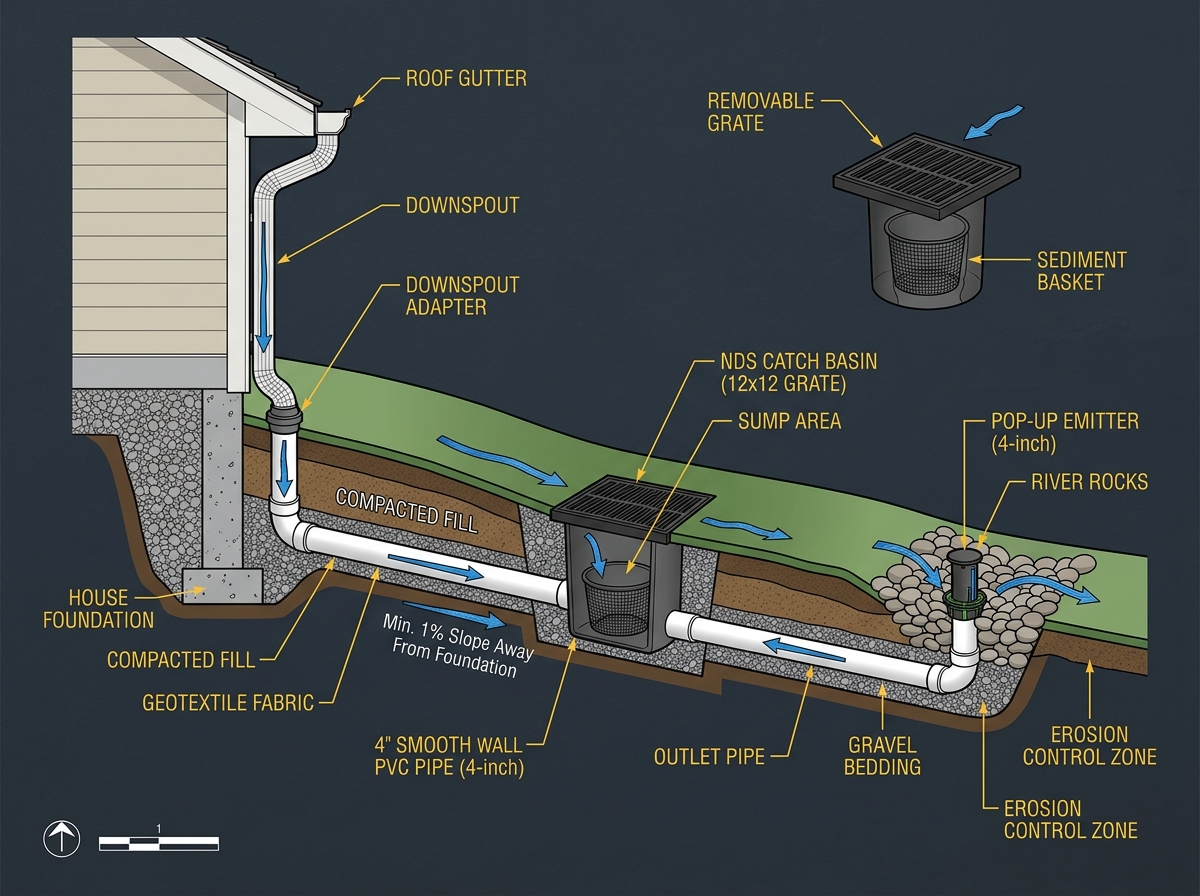
Catch Basins & Piped Downspouts
Surface water capture system connecting gutter downspouts directly into smooth-walled solid PVC pipes, routing roof runoff to safe discharge zones far away from walls.
- Pipe Type: 4" Solid Schedule 35 / PVC
- Catch Basins: 9"x9" or 12"x12" Grated Basins
- Minimum Slope: 1/8" per Foot (1% Slope)
- Discharge Outlet: Pop-Up Emitter / Bubbler
- Best For: Heavy Roof Runoff & Low Spots
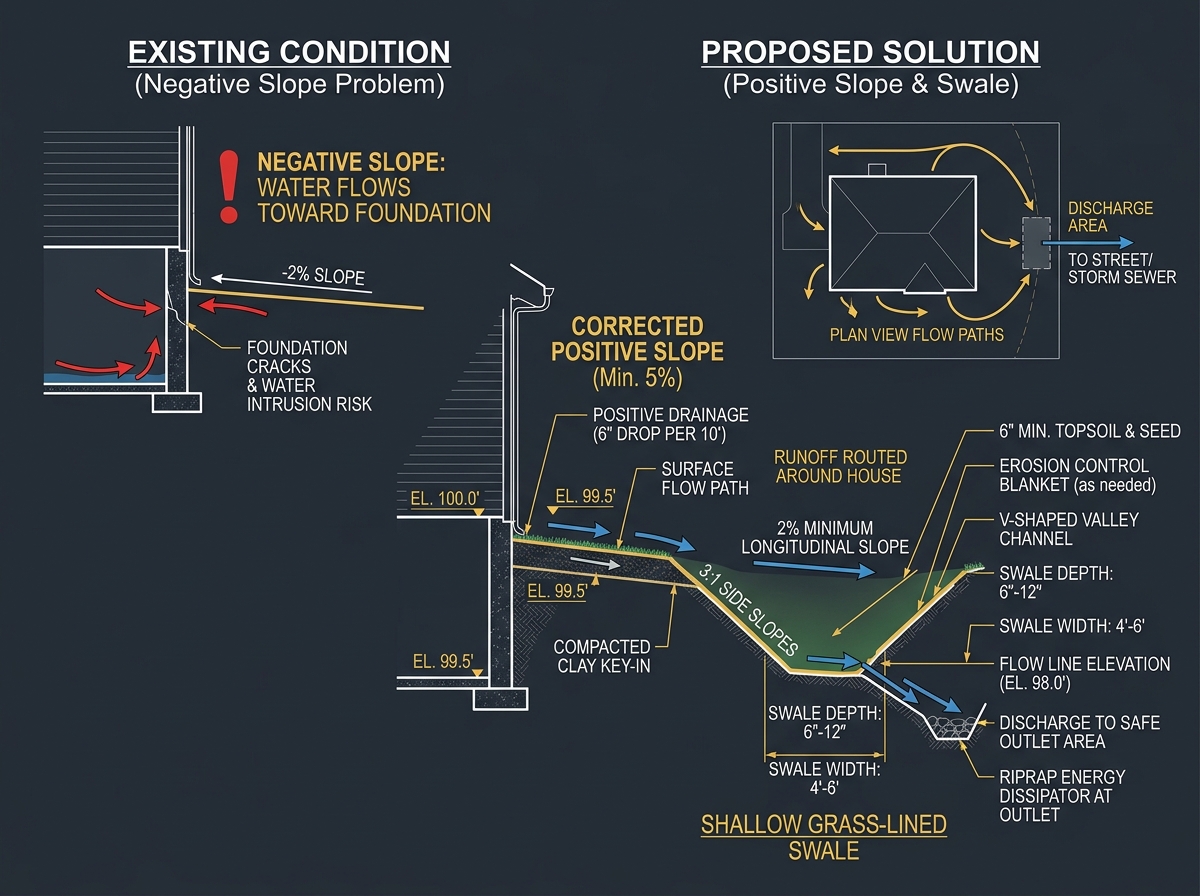
Swales & Yard Regrading
Passive landscape contouring establishing a positive 5% slope away from the house structure into a vegetated shallow swale channel that directs surface flow around the yard.
- Foundation Slope: 6" Drop over First 10 Feet
- Swale Contour: Broad V-Shaped Valley
- Slope Gradient: 2% - 5% Minimum Grade
- Vegetation Cover: Bermuda / Zoysia Sod
- Best For: Negative Grade & Surface Water
Technical Comparison Matrix
| Drainage Solution | Primary Target | Ideal Soil Depth | Clay Clogging Risk | Maintenance Level | Lifespan |
|---|---|---|---|---|---|
| French Drain | Subsurface groundwater & heavy soil saturation | 18" – 30" | Low (with geotextile wrapper) | Low (cleanout access points) | 25+ Years |
| Piped Downspouts | Gutter concentrated roof water | 12" – 18" | None (sealed smooth PVC pipe) | Low (clear debris grates annually) | 30+ Years |
| Catch Basins | Low lawn puddle spots & hardscape runoff | 12" – 24" | Very Low (sediment bucket trap) | Occasional grate cleaning | 30+ Years |
| Swale & Regrading | Broad surface overland water flow | Surface Topographic | N/A (Open Channel Flow) | Routine lawn mowing | Lifetime |
Frequently Asked Questions (Athens GA Drainage)
What are the best yard water mitigation solutions for Georgia red clay in Athens, GA?
1) French Drain Systems wrapped in non-woven geotextile filter fabric to prevent fine clay silt clogging;
2) Piped Downspout Systems using solid smooth-wall PVC pipe to carry roof water 15+ feet away from foundation footings;
3) Grated Catch Basins installed in lawn depressions; and
4) Yard Regrading establishing a 5% positive slope away from foundation walls per IRC code.